Sunday, April 12, 2009

10. Interview peers on what they feel makes an effective teacher


I went around to a handful of my friends and asked them “What makes and effective teacher?” These are some of the responses I received:
• “Passion for the subject(s) and an understanding for different learning styles.”
• “If they can express what they know in an interesting way.”
• “They use creativity and care about their students.”
• “An effective teacher is someone who can keep control of the class while using creative methods to keep attention and excitement.”
• “Relate to students in an intelligent and fun way.”
• “Keep the students interested and passionate about learning.”
• “They are spontaneous, creative, do fun things with the class and are approachable in one-on-one settings.”
• “Someone who is experienced, knows their subject, and knows how to help other people.”
• “The teacher can clearly relate the message (information.)"
I really enjoyed asking people this question, more than I expected. Some of my peers spit out an answer right away, but others had to really think about it. A couple friends would say a teachers name and then pause and think for a bit and give me a description of an effective teacher based on one person in particular. Others would think of a bad teacher and say the opposite of what that teacher did.
As I look at what others consider important in making an effective teacher, I look at my Strengths Quest list that sits on my desk. Developer, individualization, connectedness, empathy, includer- these are my strengths. In all of these strengths one of the occupations to consider is teaching. I see this as a great opportunity and calling to develop my skills and use them to the fullest when I teach. I clearly see how my strengths relate to what skills my peers consider an effective teacher to have. Now it is up to me to work at developing these skills to become an effective teacher.

Friday, April 10, 2009

1. Interview a teacher for special needs- Brooke Walls


This semester I spent a great deal of time out in the schools, which I have really enjoyed, but have defiantly felt the time crunch with three placements. For Exceptional Learners I spend time at Eastwood Elementary in Brooke Walls’ special education class. Eastwood elementary special education class is different because it is an ED class. I was able to observe inclusion alongside a Karen, a paraprofessional and with Brooke in her room.


The last day at Eastwood I sat down with Brooke and asked her a few questions. I talked with her about instruction delivery methods, inclusion and the obstacles of inclusion, the amount and type of services her classroom provides for students, her interactions with students of special needs, peer relationships for her students in and outside of her classroom, collaboration, and what biases she sees in cultural differences and minority representation in her classroom. I also asked her how she came to be at Eastwood and what being in an Emotionally Disabled classroom entails. Brooke and I talked for a good 30 minutes. One thing I find very interesting, which is different for everyone, is the journey that connects one with disabled children and adults. Brooke started off with a BA in Elementary Education with a minor in math and Spanish. She taught for a short time as an 8th grade math teacher and did not enjoy it. She wanted to work with students that would be motivated by stickers. She then went to Ireland through school. In Ireland she worked in the schools and did lots of pullout work with children, most often they were children with special needs, but there was no program for them. She really enjoyed her time in Ireland and came back with the idea of Special Education in the back of her head. When she stared at Eastwood she really didn’t know what an ED class was, but she quickly learned along the way. This is her 4th year at Eastwood teaching in her ED class. She currently getting her maters in Special Education, she started out at Eastwood with an emergency license.


I really enjoyed my time with Brooke and I found her to be a great resource when ever I had any questions. Her paraprofessionals were also great in answering any questions I had. Brooke has a really great team that makes her room friendly and inviting.

Tuesday, April 7, 2009

10. Watch movies about famous teachers & compare teachers in the media with reality


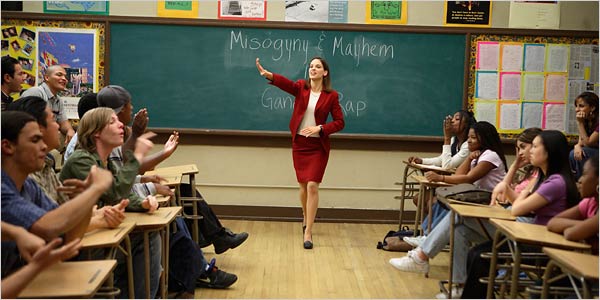
I again just recently watched Freedom Writers. This is a movie from 2007, is based on the book The Freedom Writers Diary written by Erin Gruwell. Her book is based on Woodrow Wilson Classical High School in Long Beach, California. This movie is set in the 90s when Erin Gruwell, a new teacher gets thrown into a newly integrated class, which is full of at-risk students. These students in the movie are the worst of the worse. The class is full of students who argue and don’t get along, these students are the students who no one believes they can succeed in school. The classroom is very segregated by race even though the state mandates integrated classrooms. Erin struggles to teach in an environment where her superiors are not advocates for her and society looks down on her students. Eventually she is able to gain the trust of her students and is able to prove society wrong. She follows her students into sophomore and junior year and watches most of them graduate and attend college.

This movie plays up any and every stereotype out there about intercity students, race, and naïve female teachers. Even though the movie was a bit cheesy and cliché at times, it still holds an important message of hope. I have never lived in an inner city and what the film showed is how all movies portray inner city life, so I have nothing to compare it to. One of the aspects I found most annoying and very media driven was the idea that the administration was against “good teaching.” The administration in power at the school wanted to keep power and didn’t want to hear from the young naïve teacher aspiring to chance the world.

Despite it’s extremes I really enjoyed it. Every time I see this film I wonder where I will end up teaching. This year I receive the TEACH grant and this means that I will need to teach at a title one school for at least four years. There are title one school in many different settings, but inner city schools are the stereotypical image of title one schools.
where I will end up teaching. This year I receive the TEACH grant and this means that I will need to teach at a title one school for at least four years. There are title one school in many different settings, but inner city schools are the stereotypical image of title one schools.

1. Tutoring at Goshen Middle School

March 5, 2006

This semester I have been at Goshen Middle school in Miriam Miller’s ENL class with TESOL Methods. By the end of the semester I will have been there for 20 + hours, right now I have about 10. Being at the middle school is very different from the elementary schools, but I like it. I go in two times a week for the first two periods of the day (about two and a half hours.) First period has a pretty standard set schedule. I teach half of the class on Wednesdays and then on Mondays I often tutor two of the newer students. I just recently started staying for second period and with this class I don’t do much direct tutoring. On Wednesdays I go to the library with the class and then listen to individual students read. On Mondays I do whatever needs done. The ESL classes consist entirely of students whose first language is Spanish. This is a big change for me because growing up in state college there were almost not Spanish speakers, there was one Hispanic in my class of 650. I was at a couple ENL assemblies


My students Manuel, Yanini, Yajaira, and Lizbeth are lots of fun to work with. When I started with them Lizbeth said almost nothing. The only time she would speak was when I directly asked her questions, but as time has gone on I have seen her become more comfortable with English language, which is really exciting. I have seen great improvement in all of my tutees.


The past couple of weeks I have been reminded of how it feels to be the “odd one out” in terms of language. The Latino Coalition for heath came in every Wednesday for the past couple of weeks giving presentations about nutrition and healthy eating. The presentations are conducted entirely in Spanish with a few English words sprinkled here and there. Spanish is no problem for the entire ENL body except for one girl who is from Japan and me. Miriam translates for the two of us. It is a good role reversal for me and keeps me aware of what it is to not understand the language being spoken.